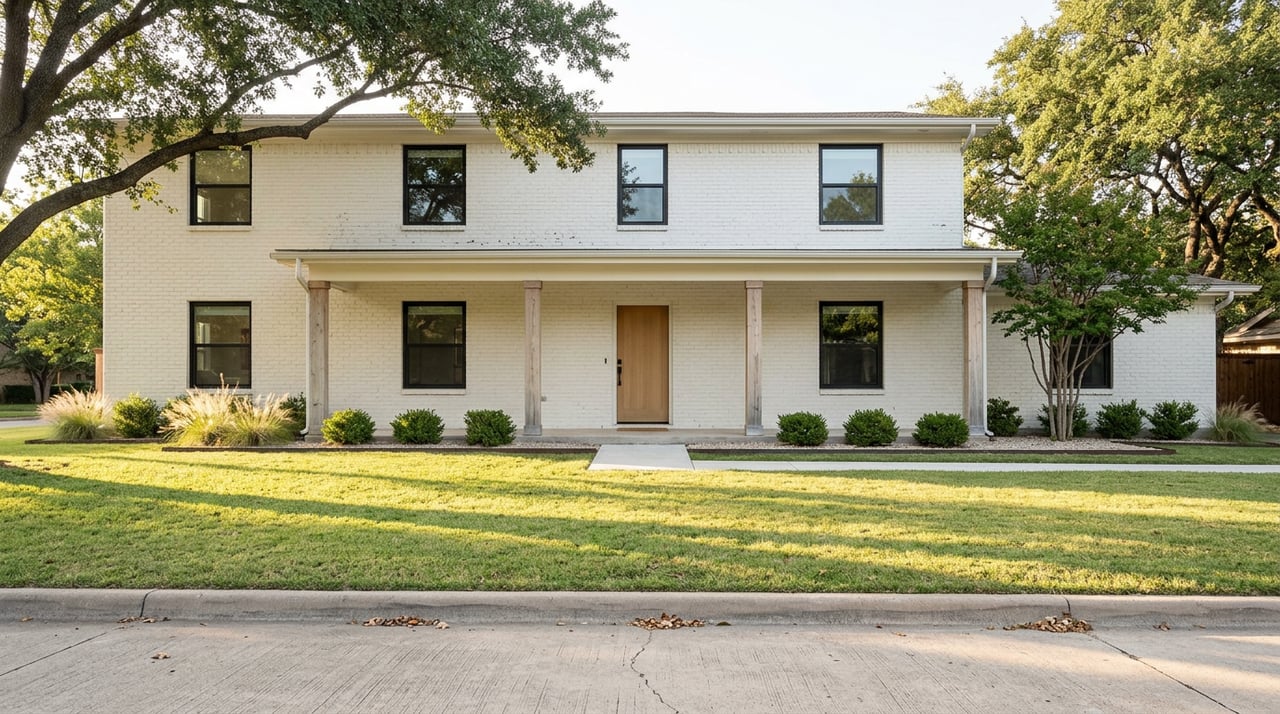
Canyon Creek Golf Course Home Value: What Drives the Premium?
September 17, 2026
September 17, 2026
Two homes hit the market in Richardson within a day of each other this year. One, a 3,626-square-foot four-bedroom on Sage Valley Drive, listed at $1,589,000, or $438 a square foot. The other, a 2,034-square-foot four-bedroom on Shady Creek Drive, listed at $675,000, or $332 a square foot. Both sit inside the same Canyon Creek footprint. Both back up to the same neighborhood identity built around one country club. The gap between them, nearly a third more per square foot for the larger home, has nothing to do with which one is closer to the fairway.
Golf-course proximity is only one factor buyers should consider. The neighborhood's whole identity runs through its golf course, so it's easy to assume proximity to the greens is the price lever. It isn't, or at least not on its own. The price difference reflects factors such as home size, condition, and which side of Lookout Drive a home is on; club membership is a separate cost to consider when comparing overall expenses.
Canyon Creek is bisected by Lookout Drive, and the split matters more than most buyers realize until they're deep into a search. Homes north of Lookout are zoned to Plano schools, including Aldridge Elementary and Wilson Middle, feeding into either Vines High School or Plano Senior High School depending on the specific address. South of Lookout, homes are zoned to Richardson ISD, with Canyon Creek Elementary and Richardson North Junior High feeding into Pearce High. Two buyers can be looking at homes six blocks apart, both a short walk from the clubhouse, and land in entirely different school districts without either one being closer to the golf course than the other.
This is worth sorting out before you fall for a listing photo. The zoning line runs down a street, not around the country club, so "close to the course" tells you nothing about which district you'll be zoned into. If school assignment is part of your decision, the map you need is the district boundary, not the golf cart path.
Homes.com describes the neighborhood as running on a voluntary homeowners association that organizes yearly community events rather than enforcing strict architectural covenants, which is part of why Canyon Creek reads as well-kept without reading as uniform. You'll find ranch homes from the 1960s next to fully rebuilt contemporaries on the same block, and that variety is doing more to explain price swings than proximity to the ninth hole.
Single-family homes in Canyon Creek run from the low $400,000s to the high millions, and condos and townhomes run from the low $200,000s to the mid $500,000s. That's a wide enough band that "median price" tells a buyer almost nothing useful. Here's what the range looked like broken out by product type, based on listings posted earlier this year:
| Product type | Approximate range | Example |
|---|---|---|
| Condo/townhome | Low $200,000s to mid $500,000s | A 1,075-square-foot two-bedroom condo with golf course and pool views listed at $243,000 |
| Mid-size single-family | High $600,000s to high $700,000s | A 2,034-square-foot four-bedroom at $675,000; a 2,657-square-foot four-bedroom at $780,000 |
| Larger/updated single-family | Low $1 millions and up | A 3,626-square-foot four-bedroom at $1,589,000 |
Notice what's doing the work in that table. The condo with golf course views is the cheapest line item, not the most expensive, because unit size and product type outweigh the view. The two homes near $700,000 to $780,000 are both four-bedroom houses in a similar size band, priced within a few percentage points of each other. The jump to the low $1 millions tracks a much larger footprint, not a different zip code or a better tee box. If you're comparing homes on the basis of "golf course adjacent" as a single filter, you're comparing a two-bedroom condo to a four-bedroom estate and calling it the same market.
Canyon Creek Country Club, which anchors the neighborhood both physically and in name, doesn't publish its membership pricing. Third-party club trackers put initiation fees anywhere from roughly $25,000 to $100,000 depending on membership type, with annual dues in the range of $5,000 to $10,000. None of that shows up in a home's list price, But if part of what you're buying into is the lifestyle, the golf, the pools, the tennis and pickleball courts, the social calendar, that's a recurring cost layered on top of the mortgage, and it's worth pricing out before you assume a golf-course lot is the better deal.
The club itself went through a real reinvestment. A multimillion-dollar renovation wrapped up in 2024 as the club marked more than sixty years since its 1963 founding, and it touched nearly everything: a redesigned course originally laid out by architect Press Maxwell, a new Press Studio fitness center, and a relaunched dining concept called Richardson's Table. That kind of capital investment tends to support resale confidence for homes near the club, but it's a different mechanism than "this house is on the golf course." It's closer to "this club just proved it can fund its own upkeep," which matters for long-term value whether or not your lot line touches a fairway.
If you're shopping Canyon Creek against other Richardson or North Dallas neighborhoods, the practical move is to stop treating "near the club" as a price category and compare home size, condition, and which side of Lookout Drive an address is on. Confirm the school district for a specific address, since that's a street-level fact, not a neighborhood-wide one, and ask when the home was last updated. A 2,034-square-foot house and a 3,626-square-foot house in the same subdivision can differ by a third in price per square foot for reasons that have nothing to do with the course. Consider club membership separately as an ongoing expense, and decide whether its amenities make sense for your household.
None of this makes Canyon Creek a harder place to buy into. It means the golf-course-community headline is only part of the picture: buyers should compare home size and condition, check the Lookout Drive line and renovation history, and treat club dues as a separate lifestyle cost. Buyers who weigh those details get a much clearer read on value than buyers who just ask how far the backyard is from the fairway.
What should buyers consider about club membership? It's worth deciding early whether the club is part of your plan, since dues are a recurring cost outside the mortgage.
Is a home directly on the golf course worth more than one a few streets away? Not automatically. Size, condition, and which side of Lookout Drive the home sits on tend to move price more than golf course frontage alone, based on listings posted earlier this year.
Why are there condos priced under $250,000 in a neighborhood known for golf estates? Canyon Creek includes a real mix of product types, from smaller condos and townhomes to large single-family estates, so the neighborhood's overall price range reflects unit size and type as much as location within it.
If you're weighing a move into Canyon Creek and want to talk through what a specific address is actually worth, given its school zoning, its renovation history, and whether club access makes sense for your household, Summer Graham and the Graham Group can walk through the comparison with you. Start your home story with us and get a free home valuation.
This article is general information, not legal, tax or financial advice. Consult a qualified professional about your situation.
Stay up to date on the latest real estate trends.
A qualified agent with years of experience in the real estate market can help you determine the best improvements to make based on your particular market. When you’re ready to learn more, connect with us today. We’re happy to help!